





Editorial Note
South Korean Education Minister Choi Kyo-jin offered his resignation on Sunday, November 22, 2026. President Lee Jae Myung accepted the resignation approximately one hour later, according to the Korean and English editions of Yonhap News Agency, both published that afternoon in South Korea.
The controversy concerns anti-cheating measures introduced shortly before the November 19 College Scholastic Ability Test, commonly called the Suneung. The examination itself, the earlier changes to its rules, and reports of suspected violations are distinct from the November 22 resignation.
The reported 111 suspected electronic-device-related violations should not be presented as 111 proven cases of AI cheating. The available accounts do not establish the final adjudication of each suspected case. This article provides educational and public-policy information, not legal advice.
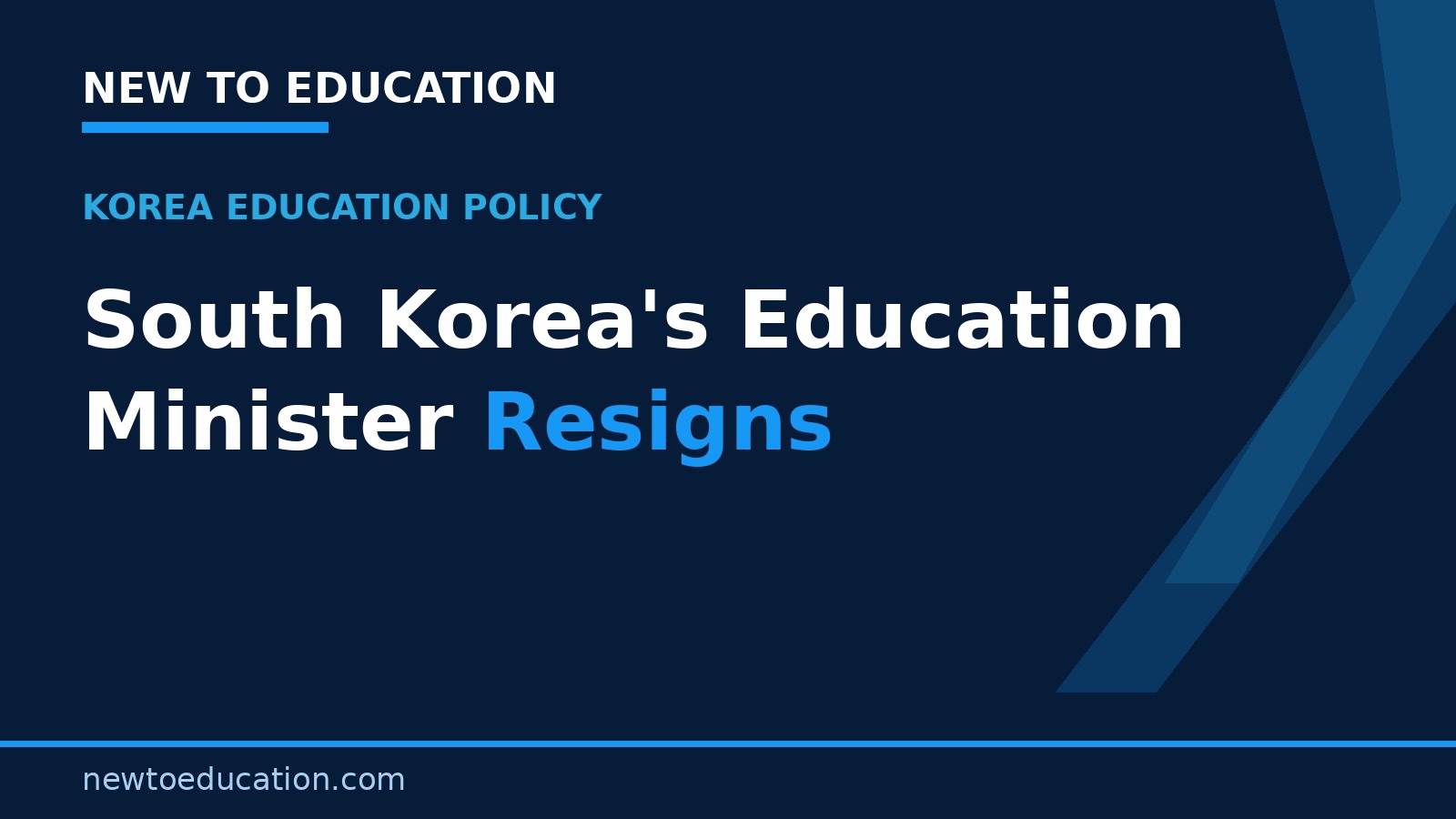
South Korea's education minister resigned November 22 following widespread criticism of last-minute changes to security procedures for the country's national college entrance examination.
Minister Choi Kyo-jin acknowledged that the changes had caused inconvenience and confusion for examination candidates and the wider public. President Lee Jae Myung accepted the resignation, beginning a leadership transition at the education ministry.
The development raises questions about how examination authorities should respond when emerging technologies create new risks shortly before a major assessment.
Bottom Line
- Choi Kyo-jin resigned on November 22.
- President Lee Jae Myung accepted the resignation the same day.
- Vice Education Minister Choi Eun-ok is expected to lead the ministry in an acting capacity pending the appointment of a successor.
- The underlying examination took place November 19.
What Happened on November 22?
Choi publicly offered his resignation through a statement distributed by the education ministry.
He said that significant changes immediately before the examination had created difficulties for candidates and others involved.
He also acknowledged criticism that the responsible ministry had not prepared adequately in advance.
Approximately one hour after the announcement, the presidential office confirmed that President Lee had accepted his resignation.
The ministry's leadership responsibilities will continue during the transition.
Why the Examination Rules Became Controversial
Education officials faced concerns that very small cameras and AI-enabled devices could be used to obtain unfair assistance during examinations.
Authorities introduced additional restrictions and security procedures shortly before the national college entrance test.
Measures reported by Yonhap included limitations on writing implements and covering certain clothing buttons to address the risk of concealed cameras.
Authorities also transmitted emergency alerts to mobile phones during the examination to help identify devices that had not been surrendered as required.
Candidates and educators criticized the timing and communication of the changes.
What the November 19 Examination Revealed
The Suneung took place on November 19.
On November 20, the education ministry reported 111 suspected examination violations involving electronic devices.
That number does not establish that all 111 incidents involved generative AI.
It also does not mean every suspected case resulted in a final disciplinary finding.
The relevant distinction is between suspected misconduct, investigation and confirmed violation.
Accurate reporting should preserve that distinction.
Why Advance Notice Matters
High-stakes examinations require predictable conditions.
Candidates prepare for months or years and need clear instructions about permitted materials and examination procedures.
Late changes can create uncertainty even when officials have legitimate reasons for strengthening security.
A student who arrives expecting one set of rules may face additional anxiety when requirements change at the last minute.
Authorities should therefore develop security procedures through careful risk assessment, advance testing and timely communication wherever possible.
AI and Modern Examination Security
Emerging technology creates challenges that conventional examination rules may not have anticipated.
Miniature cameras, discreet electronic devices and AI-powered assistance can potentially be misused in ways that threaten assessment integrity.
But security measures should be proportionate and practical.
Officials need to evaluate whether a restriction addresses a demonstrated risk and whether it creates accessibility or operational problems.
The goal should be to protect fairness without imposing avoidable burdens on honest candidates.
What This Means for Students
Students preparing for future examinations should rely on official examination guidance rather than circulating unofficial descriptions of security rules.
They should carefully review requirements concerning electronic devices, permitted materials and examination-day procedures.
If rules appear inconsistent, students should seek clarification through authorized channels.
A fair system should provide all candidates with the same reliable information in sufficient time to prepare.
What This Means for Educators and Exam Administrators
Schools and examination centers need enough lead time to train supervisors.
Changes to security procedures can affect staffing, instructions, equipment checks and student accommodations.
Authorities should also explain what happens when unforeseen circumstances occur.
A well-designed examination security plan includes communication procedures, escalation channels and ways to review operational problems afterward.
Governance and Accountability
The resignation is an administrative and political accountability development.
It does not, by itself, establish a criminal offense or prove that an individual deliberately caused examination misconduct.
Government officials can face responsibility for planning and communication failures even without a finding of criminal wrongdoing.
A leadership transition should therefore be distinguished from investigations into particular suspected examination violations.
What This Does Not Mean
South Korea did not cancel the November 19 examination through the minister's November 22 resignation.
The resignation does not prove that 111 candidates used AI to cheat.
It also does not establish that every security procedure introduced before the examination was ineffective.
Those questions require separate evidence and official decisions.
Bigger Picture
Education systems worldwide are adjusting assessment practices to account for powerful and increasingly discreet technologies.
New tools may improve learning and accessibility, but they can also create opportunities for unauthorized assistance.
An effective response requires more than stricter rules.
It requires fair procedures, appropriate technology, trained personnel and sufficient time for students to understand expectations.
What Happens Next
The education ministry will operate under acting leadership while the government begins the process of selecting a successor.
Authorities may review examination administration and future security guidance.
Any new regulations, disciplinary findings or confirmed examination outcomes should be reported separately on their actual dates.
Why This Matters
College entrance examinations can influence university opportunities and students' professional futures.
Public confidence depends on fairness, transparent rules and competent administration.
The November 22 resignation illustrates the consequences when examination policy changes are perceived as insufficiently planned.
Key Takeaways
- Education Minister Choi Kyo-jin resigned November 22.
- President Lee Jae Myung accepted his resignation that day.
- Vice Minister Choi Eun-ok is expected to act as minister.
- The underlying Suneung examination occurred November 19.
- Officials reported 111 suspected electronic-device-related violations on November 20.
- Those cases are not automatically confirmed instances of AI cheating.
- Examination security must be balanced against clear and timely communication.
Frequently Asked Questions
Did South Korea's education minister resign on November 22?
Yes. The resignation and presidential acceptance were reported that afternoon.
Was the college entrance examination held November 22?
No. The examination took place November 19.
Were 111 students proven to have used AI to cheat?
The verified reporting identifies suspected violations involving electronic devices, not 111 final findings of AI cheating.
Who will lead the education ministry?
Vice Minister Choi Eun-ok is expected to serve in an acting capacity pending the appointment of a new minister.
Final Thoughts
The November 22 resignation highlights how difficult it can be to respond to rapidly evolving examination-security threats.
Education authorities need to protect assessment integrity, but students also deserve rules that are clear, fair and communicated in time.
The lasting policy challenge will be to strengthen security without creating unnecessary uncertainty for examination candidates.
Sources





Comments (0)
No comments yet. Be the first to share a thought.