




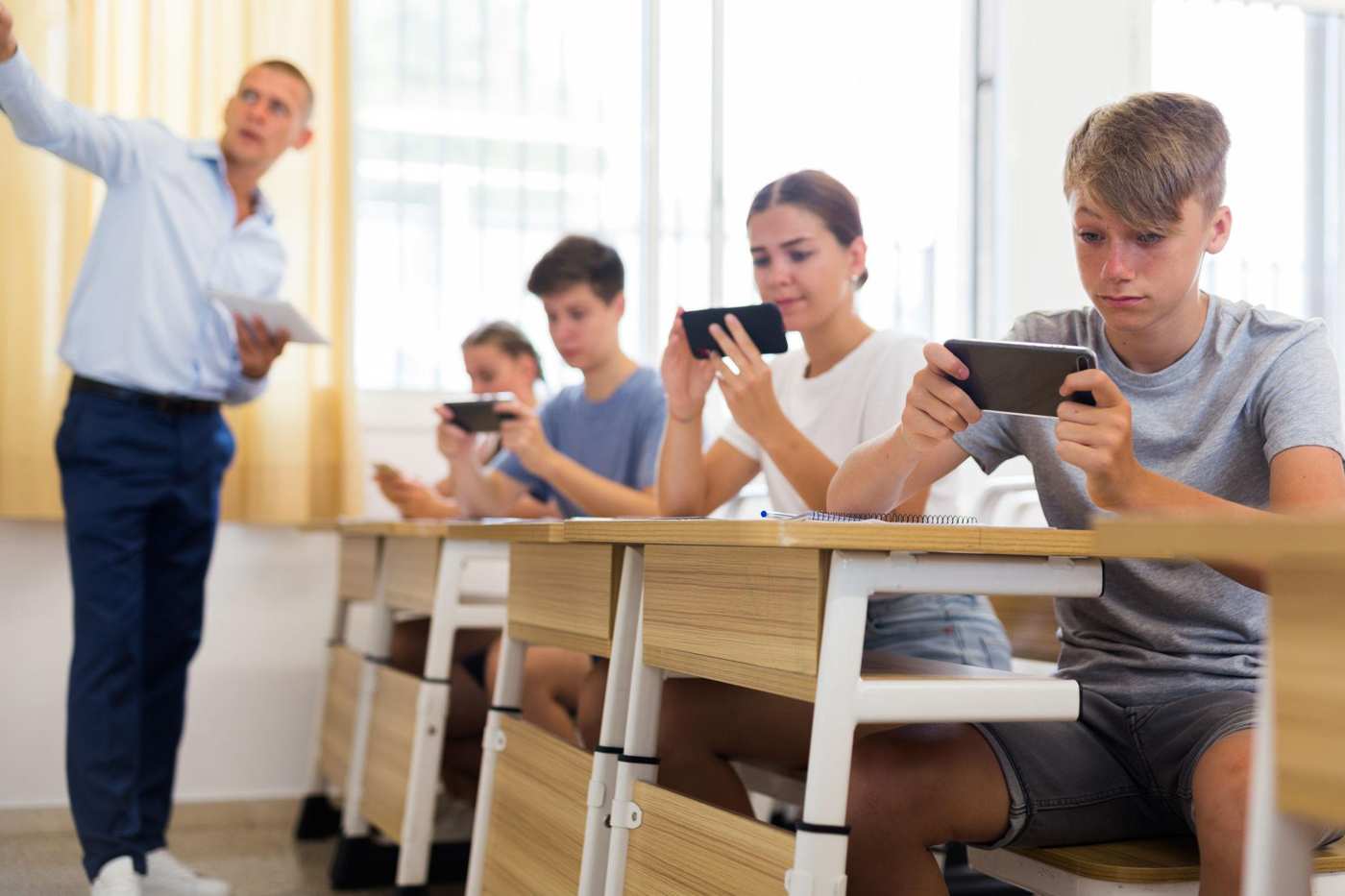

Walk through almost any school hallway today and you will probably notice the same scene repeating itself over and over again.
Students walking to class while staring at their phones. Groups of friends sitting together quietly scrolling instead of talking. Notifications buzzing during lessons. Teachers pausing instruction while waiting for students to look up from screens.
For years, many schools treated phones as a classroom distraction that simply needed better management. But recently, the conversation in California has started changing in a much bigger way.
Schools across the state are now moving toward stronger phone restrictions, and the debate is becoming one of the largest education discussions in the country.
Under California’s “Phone-Free Schools Act,” districts are expected to create policies limiting or restricting student phone use during the school day by 2026. Different schools may approach the issue differently, but the overall shift is clear: many educators believe phones may be affecting students far beyond simple distraction.
And honestly, even many students are beginning to admit it too.

The Conversation Has Become Bigger Than Phones
At first, this debate sounds straightforward. Students use phones too much in class, so schools want stricter rules.
But once you talk to teachers, parents, and students, the conversation becomes much more complicated.
Many educators now describe classrooms where maintaining attention feels harder than it did even a few years ago. Some say students struggle to focus for long periods, become mentally exhausted more quickly, or constantly shift attention between lessons and notifications.
One California teacher recently described it as “competing with the entire internet every time class begins.”
That line probably explains the issue better than any statistic.
Modern apps are specifically designed to keep people engaged for as long as possible. Endless scrolling, notifications, short-form videos, and constant stimulation have become part of everyday life for many students. Schools are now trying to figure out what learning looks like inside that environment.
Some educators believe the effects are becoming increasingly visible:
- shorter attention spans
- less face-to-face communication
- more difficulty focusing during discussions
- increased anxiety and overstimulation
- students feeling mentally drained before the school day even ends
At the same time, others argue phones are simply tools, and the real issue is learning how to use technology responsibly rather than banning it entirely.
That disagreement is part of what makes this conversation so interesting.

Some Schools Are Already Seeing Changes
Several schools that introduced stronger phone restrictions say the atmosphere in classrooms shifted surprisingly quickly.
Teachers have described students participating more during discussions, interacting with classmates more often, and becoming less distracted during lessons. Some schools even reported calmer lunch periods and fewer social conflicts tied to online drama during the school day.
One educator explained that students initially resisted the restrictions but gradually began adjusting once phones were no longer constantly within reach.
Interestingly, some students reportedly admitted they felt less pressure once they stopped checking social media throughout the day.
That does not mean every student supports these policies. Many absolutely do not. Some parents also strongly oppose broad restrictions because they want immediate communication with their children during emergencies or throughout the day.
And honestly, those concerns are understandable too.
Phones are now deeply connected to modern life. They are not disappearing anytime soon.

Schools Are Also Questioning Technology Overall
What makes California’s situation especially interesting is that the debate is no longer only about phones.
Some schools are beginning to rethink how much screen-based learning students actually need in general.
Over the last decade, classrooms rapidly expanded their use of:
- Chromebooks
- digital assignments
- online testing
- educational apps
- AI learning tools
- screen-heavy instruction
Now some educators are beginning to wonder whether schools unintentionally became too digitally dependent.
That does not mean schools are abandoning technology altogether. Most are not. Technology still offers enormous benefits in education when used thoughtfully.
But some districts are trying to rebalance classrooms by increasing:
- discussion-based learning
- handwritten work
- collaborative activities
- face-to-face interaction
- periods of reduced screen exposure
In some schools across the country, low-tech learning environments are quietly becoming popular again.
That alone says something important about where education may be heading.
The Bigger Issue May Be Attention Itself
In many ways, this debate is not really about phones.
It is about attention.
Today’s students are growing up in an environment filled with constant stimulation. Notifications never fully stop. Entertainment is always available. Social comparison follows students almost everywhere through social media.
For some students, silence itself now feels uncomfortable.
And that creates a real challenge for schools because learning often requires the exact opposite environment.
Reading carefully.
Listening patiently.
Working through frustration.
Thinking deeply about difficult ideas without immediately switching to something faster or more entertaining.
Those skills still matter. In fact, they may matter even more now.
Education Is Still Human
Technology will continue shaping classrooms. AI, online learning, and digital tools are not going away, nor should they completely.
But California’s growing phone restrictions suggest many schools are beginning to ask an important question:
How much constant stimulation is healthy for students during the school day?
Not because technology is automatically harmful, but because many educators believe students still need spaces where they can focus, communicate face-to-face, and think without interruption for a little while.
And maybe that is the larger reason this debate is spreading so quickly.
In a world filled with constant noise, schools may simply be trying to rediscover the value of attention again.




