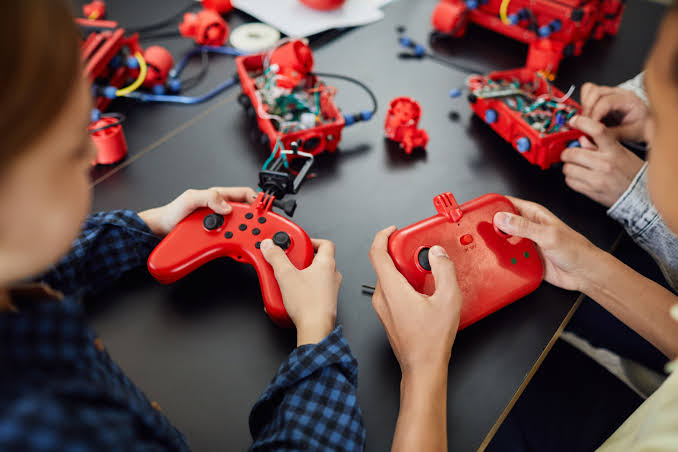

A systematic review published on July 15, 2026, examined 131 studies and found that traditional and digital toys can support children’s academic, cognitive, social, emotional, and physical development when used with clear educational purpose.
Editorial Note
This article is intended for educational and informational purposes. It summarizes a peer-reviewed systematic review rather than a controlled experiment involving one group of children. The benefits of any toy or learning activity may depend on the child’s age, developmental needs, environment, adult guidance, accessibility, and how the resource is used.
New To Education does not endorse any specific toy manufacturer, digital platform, application, or commercial learning product mentioned or implied in this article.
A child building a tower, arranging puzzle pieces, caring for a doll, moving a toy vehicle, or exploring a digital game may appear to be simply playing.
New educational research suggests that much more may be happening.
A systematic review published in Frontiers in Education on July 15, 2026, examined how traditional and digital toys are used in education and how they may affect children’s learning and overall development.
Researchers from the Vellore Institute of Technology in India reviewed 131 studies selected from the Scopus and Web of Science academic databases.
Their analysis concluded that toy-based pedagogy can improve learning while supporting cognitive, social, emotional, creative, and physical development.
The findings do not mean every toy is educational or that children should spend unlimited time with digital devices. Instead, they suggest that thoughtfully selected toys can become meaningful instructional tools when connected to clear learning goals, guided exploration, and opportunities for children to make decisions.
What Was Published on July 15, 2026?
The researchers published a systematic review titled “Exploring the Impact of Traditional and Digital Toys in Toy-Based Pedagogy on Children’s Learning and Holistic Development.”
A systematic review is different from a single classroom experiment.
Rather than studying one small group of students, researchers search for many existing studies, evaluate which ones meet predetermined standards, and combine their findings to identify broader patterns.
The research team searched Scopus and Web of Science, two major academic databases, using a structured process based on the PICO framework.
PICO traditionally asks researchers to define the population, intervention, comparison, and outcome relevant to their question.
The authors also followed PRISMA guidelines, which are commonly used to make systematic reviews more transparent and organized.
After screening the available research, they selected 131 studies for their final analysis. Their findings were organized around five themes: traditional toys, digital toys, learning and developmental outcomes, opportunities associated with toy-based learning, and challenges affecting implementation.
What Is Toy-Based Pedagogy?
Toy-based pedagogy is an educational approach that uses toys and play activities as part of structured learning.
The word “structured” matters.
Children may engage in completely open-ended play in which they determine what happens. In other situations, teachers or parents may introduce a toy to support a particular skill or concept.
Blocks can help children explore size, balance, shapes, measurement, and spatial relationships.
Puzzles can strengthen problem-solving, visual recognition, patience, and fine-motor coordination.
Dolls, figures, and pretend environments can encourage storytelling, language development, empathy, and social interaction.
Board games may reinforce counting, pattern recognition, strategic thinking, turn-taking, and emotional regulation.
Digital toys can introduce coding, interactive stories, simulations, augmented reality, or responsive learning activities.
The toy itself does not automatically create learning. Its educational value depends on what the child does with it, what ideas it makes visible, and whether adults provide an appropriate balance of support and independence.
Traditional Toys Continue to Have Educational Value
Traditional toys include physical objects such as blocks, dolls, puzzles, construction sets, puppets, balls, board games, miniature vehicles, and materials used for pretend play.
These toys can encourage children to manipulate objects directly.
A child building with blocks receives immediate physical feedback. A structure may lean, collapse, or remain stable depending on the child’s decisions. The child can then revise the design and try again.
That process involves experimentation.
The child develops a prediction, performs an action, observes the result, and adjusts the next attempt. These are early forms of scientific and engineering thinking.
Physical toys may also support motor development.
Picking up small pieces, arranging objects, drawing, connecting parts, and moving items through space can strengthen coordination and control.
Open-ended toys are particularly valuable because they do not require one predetermined outcome.
A cardboard box can become a house, vehicle, store, robot, or stage. Blocks can become almost anything the child imagines.
This flexibility encourages creativity rather than asking the child to follow only one programmed path.
Digital Toys Can Expand Learning Possibilities
Digital toys include electronic and software-supported products that respond to a child’s actions.
They may include programmable robots, interactive applications, touchscreen games, electronic building systems, augmented-reality experiences, and toys that use sensors, lights, sounds, or artificial intelligence.
These resources can provide immediate feedback.
A coding toy may move when a child enters the correct sequence of commands. A language application may pronounce a word or adjust the difficulty of a task. A digital puzzle may show a child where an error occurred.
That responsiveness can make abstract ideas easier to observe.
Digital tools may also create learning experiences that are difficult to reproduce with ordinary physical materials. Children might explore a virtual ecosystem, rotate a three-dimensional shape, experiment with music, or guide a robot through a maze.
However, digital does not automatically mean better.
A visually impressive application may offer little meaningful choice or problem-solving. Some digital toys may direct children through highly repetitive activities rather than allowing creativity.
Others may collect personal information, include advertising, encourage excessive screen time, or require subscriptions.
Parents and educators should therefore evaluate the learning design, not just the technology.
The Research Supports a Balanced Approach
The systematic review examined both traditional and digital toys rather than presenting them as enemies.
That is one of its most useful contributions.
Debates about children’s learning sometimes become overly simplistic. Physical toys may be described as naturally healthy, while digital toys are treated as harmful. In other discussions, technology is presented as more advanced and therefore automatically superior.
Both assumptions can be misleading.
A poorly designed physical toy may have little educational value. A carefully designed digital activity may help a child explore concepts in a meaningful way.
Likewise, a digital program cannot reproduce every benefit of manipulating physical objects, moving through space, negotiating with other children, or engaging in imaginative play.
The most useful approach may combine different types of experiences.
A child might construct a bridge with blocks, test it with toy vehicles, photograph the design, and use a digital application to explore how real bridges distribute weight.
The physical activity and digital resource can reinforce one another.
Play Can Support Academic Learning
Toy-based learning can help children develop skills connected to formal academic subjects.
Counting toys, dice, number cards, puzzles, and construction materials can introduce mathematical ideas.
Story figures, puppets, and pretend-play settings can encourage speaking, listening, vocabulary, sequencing, and early literacy.
Science toys may allow children to explore magnets, motion, plants, animals, water, light, or simple machines.
Building sets can introduce engineering design through planning, testing, failure, and revision.
The strongest learning may occur when children connect an abstract concept to a visible action.
A worksheet can tell a child that a square has four equal sides. Building a square with sticks or arranging tiles allows the child to see and touch that relationship.
Play also allows children to repeat an activity without necessarily experiencing it as repetitive schoolwork.
A child may count the same game pieces many times because counting is part of reaching a desired goal.
Toys May Support Social and Emotional Development
Learning involves more than academic performance.
Children also need opportunities to communicate, cooperate, wait, negotiate, manage frustration, and understand other people’s perspectives.
Shared play can create these experiences.
When children build something together, they must decide what to create, divide roles, share materials, and respond when they disagree.
Pretend play allows them to experiment with social roles and situations.
A child may act as a teacher, doctor, parent, shopkeeper, astronaut, firefighter, or community leader. Through these roles, children explore how people communicate and solve problems.
Games also create manageable experiences with success and disappointment.
Children may need to wait for a turn, follow agreed rules, lose a round, or try again after making a mistake.
Adult guidance can help children understand these emotions without taking control of the entire activity.
The goal should not be to eliminate all frustration. A reasonable amount of challenge can help children develop persistence and emotional regulation.
Holistic Development Looks at the Whole Child
The researchers emphasized holistic development.
This refers to the idea that children’s academic, emotional, social, physical, creative, and moral development are interconnected.
A building activity may involve mathematics, creativity, language, motor control, collaboration, and persistence at the same time.
Traditional schooling sometimes separates learning into narrow categories. Children complete a mathematics task, then a reading task, and later a social activity.
Play frequently combines these areas naturally.
A group of children pretending to operate a restaurant may write menus, count pretend money, discuss prices, organize materials, assign roles, communicate with customers, and solve disagreements.
The activity feels like one game, but it involves several kinds of learning.
This does not mean play should replace all direct teaching.
Children still benefit from explicit explanations, demonstrations, practice, feedback, and carefully sequenced instruction.
Toy-based pedagogy can complement those approaches by allowing children to apply ideas in active and meaningful contexts.
Adult Guidance Still Matters
Simply placing toys in a room does not guarantee that learning will occur.
Teachers and parents influence the quality of the experience through the questions they ask, the environment they create, and the amount of freedom they provide.
An adult might ask a child why a structure collapsed, what could make it stronger, or whether another design might work.
Those questions encourage thinking without immediately providing the answer.
Adults can also introduce useful vocabulary.
During a building activity, a teacher might naturally use words such as balance, foundation, height, equal, heavier, lighter, stable, or symmetrical.
The child learns the words in connection with a real experience.
Too much adult direction can reduce creativity.
When every step is prescribed, the activity becomes a set of instructions rather than play. Children may focus on pleasing the adult instead of exploring their own ideas.
The most effective role may involve preparing the environment, observing carefully, offering prompts, and stepping in when support is genuinely needed.
Expensive Toys Are Not Automatically Better
One practical lesson is that meaningful learning does not always require expensive products.
Simple materials can provide rich educational experiences.
Boxes, paper, recycled containers, wooden blocks, modeling material, string, household objects, and natural materials can support construction, sorting, storytelling, art, and experimentation.
A toy’s price does not determine the depth of learning.
In some cases, a simple object creates more possibilities because it does not tell the child exactly what to do.
Commercial products may still be useful, particularly when they are durable, accessible, and thoughtfully designed.
However, marketing terms such as “educational,” “STEM,” or “AI-powered” should not be accepted without examination.
Parents and schools should ask what the toy actually allows children to practice.
Does it encourage decisions? Does it support creativity? Can it be used in more than one way? Does it match the child’s age and needs? Does it require active thinking, or does the child mainly watch the toy perform?
Those questions are more useful than the label printed on the package.
Digital Toys Raise Privacy and Screen-Time Concerns
Connected toys can create risks that ordinary blocks or puzzles do not.
Some products contain cameras, microphones, internet connections, location tools, user accounts, or systems that collect information about how a child interacts with the device.
Parents and schools should review what information is collected, whether the toy requires an account, who can access the data, and whether information is used for advertising or product development.
Security also matters.
A connected toy may become a privacy risk if it uses weak passwords, receives few software updates, or sends information without adequate protection.
Screen time is another concern.
The educational quality of an activity matters more than simply counting minutes, but time still matters. Digital play should not consistently replace sleep, physical movement, outdoor activity, conversation, or interaction with other children.
A balanced learning environment allows technology to serve a purpose without dominating the child’s day.
Accessibility Should Be Part of Toy Selection
Children do not all interact with toys in the same way.
A child with limited fine-motor control may struggle with small pieces. A child with a visual impairment may need tactile or audio features. A child sensitive to sound may find a noisy electronic toy overwhelming.
Children with communication differences may benefit from visual supports, predictable activities, or toys that allow nonverbal participation.
Educators should consider whether toys can be adapted.
Larger pieces, textured surfaces, adjustable sound, simplified controls, switches, alternative grips, or collaborative use may help more children participate.
Inclusive play does not always require a completely separate product.
Sometimes a modest change in the materials, rules, space, or adult support can make an activity accessible.
Toy-based pedagogy is most effective when all children have a meaningful role rather than merely being present while others control the activity.
The Review Identified Implementation Challenges
The researchers did not suggest that toy-based learning is effortless.
Teachers may lack training in selecting toys, connecting play to curriculum goals, assessing learning, or managing classrooms during active activities.
Schools may face limited budgets, insufficient space, large class sizes, safety concerns, and pressure to prioritize examinations.
Digital toys may create additional costs for devices, software, maintenance, internet access, and technical support.
There may also be cultural differences in how adults view play.
Some families may worry that children are not learning unless they are completing visible written work. Teachers may therefore need to explain the skills being developed and show how the activity connects to academic goals.
Implementation should be intentional.
Schools should not purchase large collections of toys without deciding how they will be used, who will maintain them, and how teachers will evaluate whether they improve learning.
The Study Has Important Limitations
A systematic review can identify patterns across a large body of research, but its conclusions depend on the quality of the studies included.
The 131 studies may have used different age groups, toys, definitions, teaching methods, and measurements of learning.
Some may have examined brief activities, while others followed children for longer periods.
Studies showing positive outcomes may also be more likely to be published than studies finding no benefit.
The review concluded that toy-based pedagogy significantly improved learning and holistic development, but that statement should not be interpreted as proof that every toy-based activity will produce the same result.
More research is needed to determine which approaches work best for particular ages, subjects, learning needs, and educational environments.
The review provides a broad direction rather than a universal recipe.
What This Means for Teachers
Teachers can use toys as tools for exploration rather than rewards reserved for after academic work is finished.
A lesson might begin with direct instruction and then allow students to apply the concept through play.
Educators should identify the intended learning goal before selecting the materials.
If the goal is understanding patterns, the toy should allow students to create, extend, compare, or explain patterns.
If the goal is collaboration, the task should require meaningful cooperation rather than allowing one student to complete everything alone.
Teachers can observe the language students use, the strategies they attempt, the mistakes they make, and how they revise their thinking.
Documentation may include photographs, student explanations, drawings, short reflections, or demonstrations.
This can help show that play is producing visible learning rather than functioning only as entertainment.
What This Means for Parents
Parents do not need to turn every moment of play into a formal lesson.
Children need time to explore without constant questioning or correction.
However, adults can occasionally extend learning through conversation.
A parent might ask what the child is building, how two objects are different, what might happen next, or how a problem could be solved.
Reading stories connected to the child’s play can also introduce new vocabulary and ideas.
Parents should pay attention to what keeps the child actively engaged.
A toy that quickly becomes boring may offer fewer possibilities than an ordinary set of blocks, art materials, or pretend objects.
The best toy may not be the one with the most features.
It may be the one that gives the child the most ideas.
Key Takeaways
A systematic review published in Frontiers in Education on July 15, 2026, examined traditional and digital toys in education.
The researchers reviewed 131 studies identified through Scopus and Web of Science.
The review concluded that toy-based pedagogy can support children’s learning and holistic development.
Traditional toys can promote creativity, physical manipulation, cooperation, storytelling, and problem-solving.
Digital toys can provide interactive feedback, simulations, coding activities, and adaptable learning experiences.
Neither physical nor digital toys are automatically educational. Their value depends on their design, purpose, context, and the way children use them.
Adult guidance can deepen learning, but excessive direction may limit creativity and independence.
Schools should consider cost, privacy, accessibility, teacher preparation, curriculum alignment, and screen time before introducing new products.
FAQ
What educational research was published on July 15, 2026?
Researchers published a systematic review examining how traditional and digital toys affect children’s learning and holistic development.
How many studies were included?
The researchers selected 131 studies for their final synthesis.
What is toy-based pedagogy?
Toy-based pedagogy uses toys and play experiences intentionally to support learning and child development.
Are digital toys better than traditional toys?
The review did not establish that one category is always better. Traditional and digital toys can provide different benefits and may be most effective when selected according to the learning goal.
Does playing with toys replace direct instruction?
No. Toy-based learning can complement explanations, modeling, guided practice, feedback, reading, and other instructional methods.
Do educational toys need to be expensive?
No. Simple and open-ended materials can support creativity, language, mathematics, science, cooperation, and problem-solving.
What should parents consider before buying a digital toy?
Parents should examine the learning purpose, age suitability, data collection, advertisements, account requirements, security, screen-time demands, and whether the toy encourages active participation.
Can toy-based learning support children with disabilities?
Yes, but toys and activities may need to be adapted for different physical, sensory, communication, or developmental needs.
Final Thoughts
The July 15 research reinforces something children have demonstrated for generations: play can be serious learning.
When children build, pretend, sort, test, negotiate, create, and revise, they are doing more than passing time.
They are exploring how the world works.
Traditional toys allow children to manipulate physical objects and create their own meanings. Digital toys can provide responsive environments, simulations, and new forms of interaction.
Both can be valuable. Both can also be used poorly.
The important question is not whether a toy is physical or digital.
It is whether the experience encourages children to think, communicate, experiment, create, and participate actively.
Education does not always need to look like a worksheet or lecture to be meaningful.
Sometimes learning looks like a tower falling down and a child deciding to build it again differently.
Related Articles
Japan’s Wonder Meets 2026 Brings 2,500 Children and Parents Together to Celebrate Critical Thinking
https://www.newtoed.com/view-blog/japans-wonder-meets-2026-brings-2500-children-and-parents-together-to-celebrate-critical-thinking-6a53005d664a5
UCLA’s “Preschool on Wheels” Shows How Early Learning Can Meet Families Where They Are
https://www.newtoed.com/view-blog/uclas-preschool-on-wheels-shows-how-early-learning-can-meet-families-where-they-are-6a4db356ce72c
Sources
Frontiers in Education — Latest Education Research Published July 15, 2026
PRISMA — Preferred Reporting Items for Systematic Reviews and Meta-Analyses