




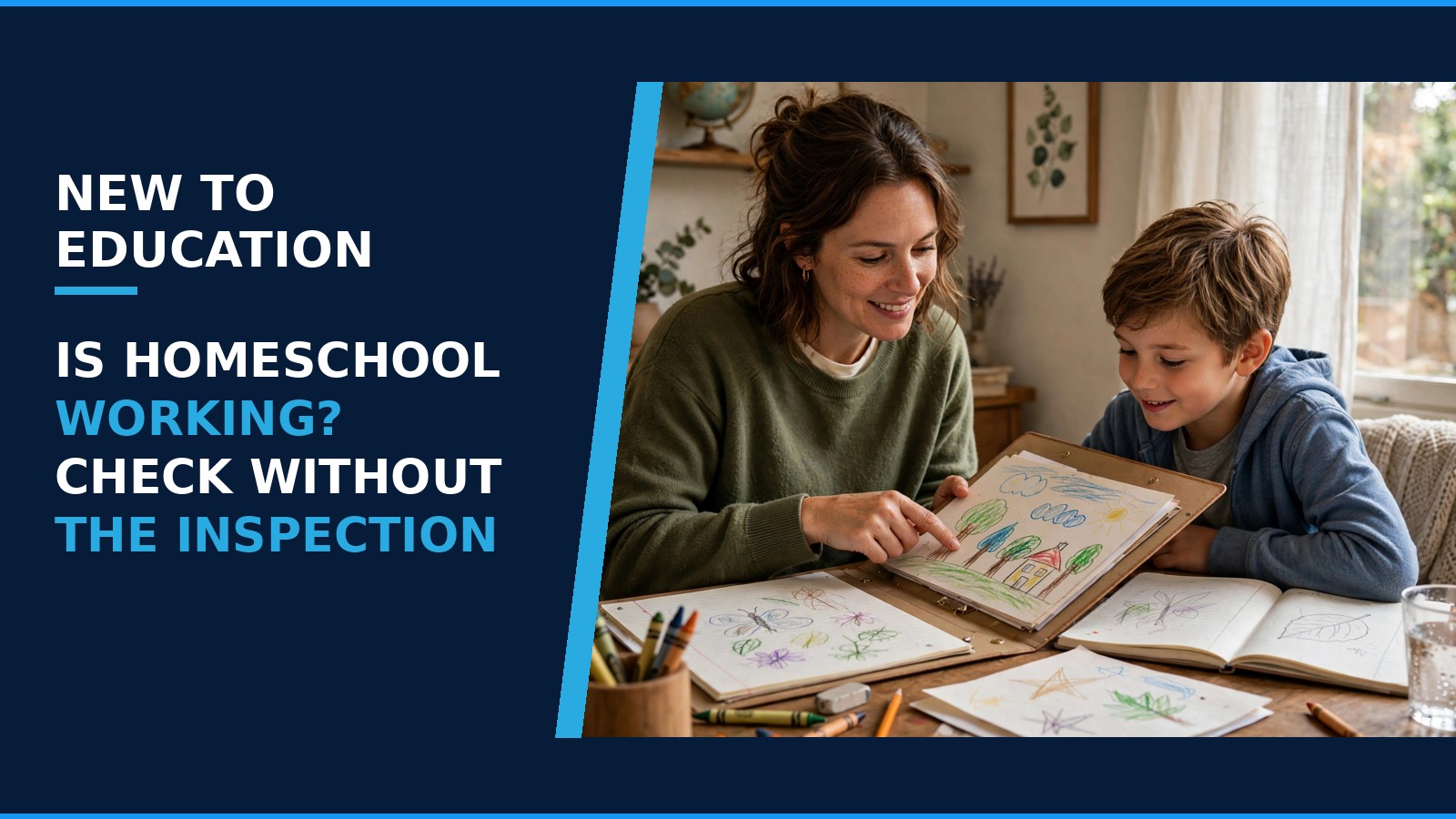

Listen to this episode: Is Homeschool Working? How to Check Without Turning Home Into an Inspection — The New To Education Podcast (6 minutes 51 seconds)
Introduction
Every homeschool parent knows the quiet moment. The day has gone reasonably well, the work is done, nobody cried over maths — and then, in the evening, the question arrives anyway: is this actually working? In a school, that question is answered, however imperfectly, by someone else: a teacher's marks, a report card, a test the parent did not set and does not grade. At home, the parent is the teacher, the marker, and the person lying awake wondering about gaps. The temptation is to resolve the uncertainty by checking more: more quizzes, more oversight, more comparison with what a classroom would have covered by now.
This article, the companion to Episode 5 of The New To Education Podcast, argues that the answer is not more checking but better checking. A homeschool does not need daily inspection to be accountable. It needs a few honest signals, gathered on a calm and predictable rhythm: progress measured against the child's own starting point rather than someone else's pace, dated work samples that make growth visible over months, ordinary conversation that reveals understanding, and one slightly more formal check every six to eight weeks that ends in a short, useful note. Done that way, checking stops being a source of dread for the child and anxiety for the parent, and becomes what it should be — the way a family chooses what to learn next.
What We Know
Homeschooling is an established part of American education. According to the National Center for Education Statistics' Parent and Family Involvement in Education survey for 2023 (NCES 2024-113), 3.4 percent of U.S. students in kindergarten through grade 12 were homeschooled in the 2022–23 school year, and 5.2 percent received instruction at home when full-time virtual schooling is included. Those families are, by design, the people responsible for judging whether learning is happening — there is no separate institution doing that judging for them.
Two further points from the evidence base shape the method this article recommends. First, the Institute of Education Sciences practice guide Organizing Instruction and Study to Improve Student Learning recommends using quizzing and recall as part of learning and spacing learning over time, and it also recommends helping students judge accurately what they do and do not yet know. In a homeschool, those principles translate into low-stakes ways of surfacing understanding — a child explaining material back, or answering questions with the book closed — rather than frequent formal testing. Second, homeschool families operate under requirements that vary by place: depending on the state or country, a family may need to give notice, keep particular records, complete assessments, or present a portfolio for review. A family's checking system is therefore never only a teaching tool; for many families it is also the record that demonstrates compliance.
Editorial Note
Homeschool law differs substantially by state and by country, and this article is not legal guidance. Requirements mentioned here are described in general terms only; confirm your own place's rules for notice, instruction, records, assessment, and portfolio review with your state education agency or a homeschool association in your state, and build your records to match what your place actually requires. Nothing in this article diagnoses a learning difficulty or replaces assessment where a parent suspects one. The six-to-eight-week rhythm and the sampling habits described are practical guidance offered for many families, not rules — a child working well ahead, or one rebuilding a foundation, may need a different cadence.
Main Analysis
Judge progress against your child's starting point, not against someone else's pace
The most common way homeschool checking goes wrong is comparison. A parent measures today against a classroom timetable, against another homeschool family sharing its week online, or against the chapter a school class would have finished by now. That comparison feels rigorous, but it measures pace against someone else's plan, for someone else's child. It tells a family almost nothing about the only question that matters: compared with six or eight weeks ago, what can this child now do that they could not do then? Progress and pace are different things. A child who is moving more slowly through a maths programme but who has genuinely mastered each step is progressing. A child racing through pages they half-understand is not, however reassuring the page count looks. Anchor your judgement to the child's own earlier work, and the picture becomes both calmer and more accurate.
Keep work, do not just finish it: the dated portfolio
Day-to-day growth is nearly invisible, which is precisely why parents feel unsure even when things are going well. The remedy is embarrassingly simple: keep a small sample of work from each main subject every few weeks — one piece of writing, one page of maths, one reading response or a photograph of a project — dated and filed in a folder, physical or digital. That folder is a portfolio, and its power appears when it is read across time. Writing from September beside writing from November shows length, clarity, and control that no single day's impression could prove. Maths pages show errors that once appeared on every exercise now appearing once. The portfolio is not there to be graded. It is there to show a direction, and to give both parent and child visible evidence that the work is adding up. It also happens to be exactly the kind of organised evidence many portfolio-review processes ask families to present.
Teach-back: a check that feels like a conversation
A portfolio shows what a child produced. Teach-back shows what a child understood. Once or twice a week, in an ordinary moment — cooking, walking, driving — ask your child to explain something they have been learning, in their own words. If they can explain why a fraction works, or retell a history chapter and say what mattered in it and why, that understanding is real in a way a completed worksheet cannot guarantee. If the explanation falls apart in the same place each time, you have found a gap calmly, in conversation, weeks before a test would have found it under pressure. This is the homeschool version of the recall and self-judgement the IES practice guide recommends: retrieval as part of learning, not as an ambush. Keep it light, keep it curious, and stop while it is still enjoyable. The moment teach-back becomes an interrogation, it stops yielding honest information, because the child starts performing caution instead of explaining thinking.
One calmer, bigger check every six to eight weeks
Samples and conversation carry most of the weight, but a homeschool also benefits from an occasional slightly more formal check — roughly every six to eight weeks, in just one or two subjects at a time. Use the end-of-unit questions from your own materials, a piece of writing read by a fresh pair of eyes, or a session with a tutor who can say plainly where your child stands. Rotate which subject gets the bigger check, so no single week becomes examination week. Then do the step families most often skip: write down what you learned, in two or three lines. What is solid. What is shaky. What we will do next. That short note, repeated across a year, is the most valuable record a homeschool parent keeps, because it turns impressions into decisions and makes the next check a comparison against something written rather than something vaguely remembered.
Know your local requirements, and let your records serve both purposes
Requirements for homeschooling vary widely. Some places ask for notice of intent, specified records, periodic assessment, or a portfolio review; others ask for very little. The portfolio habit and the short progress notes described above serve a family twice: they guide the teaching week by week, and they form the organised evidence a review process is likely to request. The mistake to avoid is guessing — assuming your place requires what a friend's state requires, or assuming it requires nothing because a forum said so. Check the actual rules with your state education agency or a state homeschool association, note the dates and formats your place specifies, and shape your folder to match. Compliance gathered as a by-product of good teaching habits costs a family almost nothing; compliance reconstructed in a panic the week before a deadline costs a great deal.
Predictability is what keeps checking from becoming surveillance
Children rarely object to being checked. They object to being checked unpredictably, whenever a parent's anxiety spikes. So set the rhythm in advance and share it: samples go in the folder on Fridays; teach-back happens in ordinary moments, not as a summons; the bigger check happens on a known day every six to eight weeks, and when it is done, it is done. Say the purpose out loud, and mean it: we check so we can choose what to learn next, not to catch you out. A rhythm the child can anticipate turns assessment into a routine feature of a fair system. Checking that appears without warning turns the whole home into a place where a test might be happening at any moment — which is the inspection atmosphere most homeschool families chose this path to escape.
Worry about patterns across a month, not about a slow week
Not every wobble deserves a response. A slow week, a bad day, a topic that needs a second pass — these are normal features of learning anywhere. The signals worth acting on are patterns sustained across roughly a month: the same confusion returning in sample after sample; reading that is not moving at all despite regular practice; a child who has stopped asking questions and is merely getting through the work; or avoidance that attaches to one subject every single time. Read those patterns as information, not failure. Each usually points to one specific change: a different explanation, more practice at an earlier step, a slower pace in that subject, or outside help with that one thing. Change one thing, note it, and look again in a few weeks. Families who change everything at once never learn which change worked.
Where a tutor fits, without taking over the homeschool
Outside help earns its place in a homeschool at specific points, not as a general replacement for the parent's teaching. A tutor can take the subject the parent is least confident teaching — later maths and science are the common examples — give an honest outside read on writing or maths during one of the periodic checks, or work directly on the one pattern the progress notes keep naming. Because one-to-one online sessions sit inside the family's own plan and timetable, they support the homeschool's design rather than competing with it. The parent remains the designer of the education; the tutor is a specialist the designer calls in, for a defined job, with the notes to prove whether the job is getting done.
Episode Timestamps
- 0:00 — Welcome: the question every homeschool parent asks
- 0:35 — Why comparison measures pace, not progress
- 1:20 — The dated portfolio: making growth visible
- 2:10 — Teach-back: a check that feels like a conversation
- 2:55 — The six-to-eight-week check, and the two-line note
- 3:45 — Local requirements: let your records serve both purposes
- 4:30 — A predictable rhythm, so checking never becomes surveillance
- 5:15 — Patterns worth worrying about — and changing one thing
- 5:55 — Where a tutor fits inside a homeschool — and the recap
Key Takeaways
- Judge progress against your child's own starting point six to eight weeks ago, not against a classroom timetable or another family's pace.
- Keep dated samples from each main subject in a simple portfolio; growth that is invisible day to day becomes obvious across months.
- Use teach-back in ordinary moments to check understanding without a test, and note where explanations repeatedly fall apart.
- Every six to eight weeks, run one calmer check in a rotating subject or two, and write down what is solid, what is shaky, and what comes next.
- Know your own place's requirements and keep a predictable rhythm, so your records serve both your teaching and any review — without turning home into an inspection.
Frequently Asked Questions
How often should I formally test my homeschooled child? For most families, far less often than anxiety suggests. Let dated work samples and teach-back carry the weekly picture, and reserve a slightly more formal check — end-of-unit questions, an outside read on writing, a tutor session — for every six to eight weeks, rotating subjects. Your own place's rules may also specify assessments; check those first, because a required assessment sets its own timetable.
What should go in a homeschool portfolio? A small, dated sample from each main subject every few weeks: a piece of writing, a page of maths work, a reading response, photographs of projects or practical work, plus your short progress notes after each periodic check. Small and regular beats large and occasional — the portfolio's value is the comparison across time, and it doubles as organised evidence if your place requires a portfolio review.
My child is behind the level their school friends are at. Should I worry? Not on that evidence alone. Compare your child with their own work from six to eight weeks ago first. Steady progress from their own starting point is a working homeschool, even at a different pace. Worry instead about a pattern across a month — the same confusion returning, reading not moving despite regular practice, questions stopping — and respond by changing one specific thing, then checking again.
What records do I legally have to keep? It depends entirely on where you live; requirements range from minimal to detailed notice, records, assessment, and portfolio review. This article cannot answer for your state or country. Ask your state education agency or a state homeschool association, write down what your place requires, and shape your portfolio and notes to match it.
When should a homeschool family bring in a tutor? When your notes name a specific job: a subject you are not confident teaching, an outside judgement on writing or maths at a periodic check, or a pattern — a recurring confusion, stalled reading — that your own changes have not shifted. A tutor hired for a defined job inside your plan supports the homeschool; you remain its designer.
The Bottom Line
A homeschool parent does not need to choose between trusting the process and knowing whether it works. The middle path is a small system: progress judged against the child's own starting point, dated samples in a portfolio that makes growth visible, teach-back woven into ordinary moments, one calmer check every six to eight weeks that ends in a two-line note, and records shaped to the rules of the place you actually live in. Kept on a rhythm your child can predict, that system produces something daily inspection never does — honest information, gathered without fear, that tells a family exactly what to learn next. Checking, done this way, is not the opposite of a warm homeschool. It is what protects one.
Support New To Education
When your progress notes name a specific gap — a subject you would rather hand to a specialist, or a pattern that needs an outside eye — New To Education connects homeschool families with independent tutors for one-to-one online support that fits inside your family's plan. Browse tutors and book a first class at newtoeducation.com — and for help choosing well, download the free Tutor-Choice Checklist via the podcast show notes.
Related Articles
- Online Tutoring for Homeschool Families: Building a Weekly Schedule That Works — how to place tutoring sessions inside a homeschool week so they support the family's rhythm instead of fragmenting it.
- How to Compare Homeschool Rules by State Without Getting Overwhelmed in 2026 — a framework for reading your own state's notice, records, and assessment requirements clearly.
- Help Your Child Actually Remember What They Study: Recall, Spacing, and the Habits That Work — the recall and spacing habits behind this article's teach-back check, from Episode 3 of this podcast.
Sources
- National Center for Education Statistics — Parent and Family Involvement in Education: 2023 (NCES 2024-113): 3.4 percent of K–12 students homeschooled in 2022–23; 5.2 percent receiving instruction at home including full-time virtual schooling. https://nces.ed.gov/pubs2024/2024113_Summary.pdf
- Institute of Education Sciences — Organizing Instruction and Study to Improve Student Learning (IES Practice Guide, NCER 2007-2004): recommendations on spacing learning over time, using quizzing and recall to promote learning, and helping students judge what they know.
- The New To Education Podcast, Episode 5: "Is Homeschool Working? How to Check Without Turning Home Into an Inspection" (November 25, 2026) — the episode this article accompanies.
Transcript
Danielle: Welcome to The New To Education Podcast, where education has no borders. I am Danielle, one of your hosts. New To Education offers personalized one to one online tutoring in more than twenty-eight subjects, and this is the show where we help parents make the most of it.
Alex: And I am Alex, your other host. Last time we built a calm plan for the S A T and the A C T. Today we are talking about homeschool support, and a question I hear from homeschool parents all the time. How do I know if this is actually working, without turning every day at home into an inspection?
Danielle: That tension is real, and it is healthy. You chose this path because you wanted learning to feel more human, not less. But you are also the teacher, the principal, and the person who worries at night about gaps. The answer is not to check everything, every day. The answer is to check a few honest things, on a calm rhythm, and to keep the evidence as you go.
Alex: Where do parents usually start, and why does it backfire?
Danielle: Many start by comparing. They compare today with a classroom timetable, or with another homeschool family online, or with the chapter their child would have finished in school by now. Comparison tells you almost nothing useful, because it measures pace against someone else's plan, not progress against your own child's starting point. A better question is simpler. Compared with six or eight weeks ago, what can my child now do that they could not do then?
Alex: So progress, not pace. How do you actually see that progress without a test every week?
Danielle: Keep work, do not just finish it. Save a small sample from each main subject every few weeks. One piece of writing, one page of math work, one reading response or project photo. Date it and put it in a folder, physical or digital. That folder becomes a portfolio. When you look back across two or three months, growth that is invisible day to day becomes obvious. The writing is longer and clearer. The math mistakes that used to appear on every page now appear once. You are not grading the folder. You are letting it show you a direction.
Alex: That sounds gentle, but is a folder of work enough? What about checking understanding in the moment?
Danielle: Add one more habit, and keep it light. Once or twice a week, ask your child to teach something back to you, or explain it in their own words while you cook or walk together. If they can explain why a fraction works, or retell a history chapter and say what mattered in it, that understanding is real. If the explanation falls apart in the same place each time, you have found a gap calmly, weeks before a test would have found it angrily. Teach-back is a check that feels like a conversation, because it is one.
Alex: What about the subjects where a parent is less sure of their own knowledge? Older math, science, writing feedback?
Danielle: That is where an outside eye helps most, and it does not need to be constant. Every six to eight weeks or so, do one slightly more formal check in just one or two subjects. Use the end of unit questions from your own materials, a short piece of writing read by someone else, or a session with a tutor who can tell you plainly where your child stands. Rotate the subject you check, so no single week becomes examination week. And write down what you learn in two or three lines. What is solid, what is shaky, and what we will do next. That short note is the most valuable record a homeschool parent keeps.
Alex: I can hear a parent thinking, but what about requirements? Some places expect records or reviews.
Danielle: Yes, and this is important. Homeschool requirements vary a lot by state and by country. Some places ask for notice, records, assessments, or a portfolio review. Others ask for very little. The portfolio habit and the short progress notes we just described serve you twice. They guide your teaching, and they are exactly the kind of organised evidence many review processes ask for. But do not guess your own rules. Check them with your state education agency or a homeschool association in your state, and build your folder to match what your place actually requires.
Alex: How do you keep all of this from slowly turning into surveillance? Because a weekly check can creep.
Danielle: Set the rhythm in advance, and share it with your child. For example, samples go in the folder on Fridays. Teach-back happens when it happens, in ordinary moments, not as a summons. The bigger check happens once in a while, on a day you both know about, and when it is done, it is done. Children accept checking that is predictable and fair far more easily than checking that appears whenever a parent feels anxious. And be honest about the purpose out loud. We check so we can choose what to learn next, not to catch you out.
Alex: What signs should a parent actually worry about, then?
Danielle: Worry less about a slow week, and more about a pattern across a month. The same confusion returning in every sample. Reading that is not moving at all despite regular practice. A child who has stopped asking questions and is just getting through the work. Or avoidance that is really about one subject every single time. Those patterns are information, not failure. They usually point to one specific thing to change. A different explanation, more practice at an earlier step, or outside help in that one subject. Change one thing, then look again in a few weeks.
Alex: And where does a tutor fit for a homeschool family, without taking over the homeschool?
Danielle: Right in that gap, and only there. A tutor can take the subject you are least confident teaching, give an honest outside read on writing or math, or work on the one pattern your notes keep naming. Because the sessions are one to one and online, they sit inside your family's plan rather than replacing it. At New To Education, homeschool families use tutors that way at new to education dot com, choosing support for a specific subject or skill. And your first class is ninety percent off with the code N, two, E, D.
Alex: Let us land it for a parent listening tonight who feels unsure.
Danielle: Remember five things. Judge progress against your child's own starting point, not against someone else's pace. Keep dated samples in a simple portfolio, so growth over months becomes visible. Use teach-back in ordinary moments to check understanding without a test. Do one calmer, slightly bigger check every six to eight weeks, rotating subjects, and write down what is solid, what is shaky, and what comes next. And know your local requirements, so your records serve both your teaching and any review. Checking is not the opposite of a warm homeschool. Done on a rhythm, it is what protects it.
Alex: Thanks for listening to The New To Education Podcast, where education has no borders.
Danielle: Find New To Education online at new to education dot com, and remember, your first class is ninety percent off with the code N, two, E, D. Next time, we will talk about motivation and confidence, and what to say when your child tells you, I am just not good at this. Until then, keep asking good questions. Your child's learning is worth it.







Comments (0)
No comments yet. Be the first to share a thought.