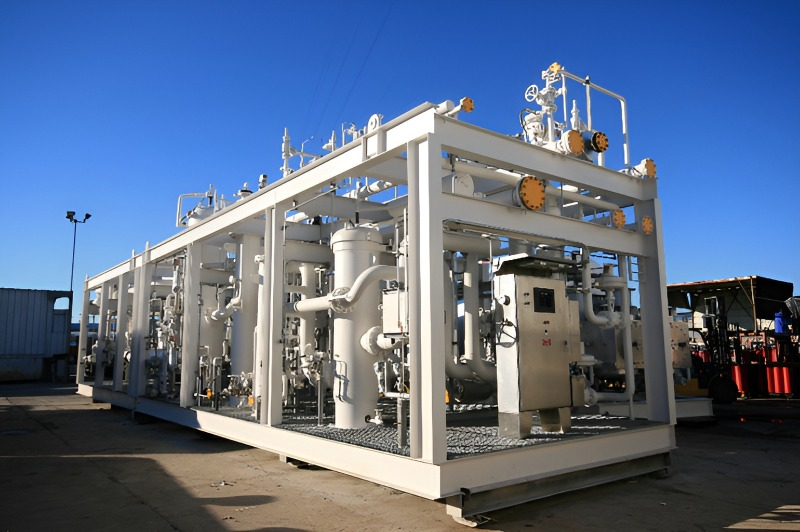
The University of Cambridge has opened a new rapid-testing facility designed to combine high-pressure physical experiments with artificial intelligence. Researchers say the system could reduce aerospace and energy technology-development cycles from years to weeks while supporting cleaner aircraft, advanced engines, and new British manufacturing industries.
Editorial Note
This article provides independent reporting and educational analysis about a newly opened engineering research facility. It does not provide technical, investment, procurement, aviation-safety, or government-policy advice.
New To Education is not affiliated with, sponsored by, endorsed by, or acting on behalf of the University of Cambridge, the Whittle Laboratory, the Bennett Innovation Lab, Rolls-Royce, the Aerospace Technology Institute, Innovate UK, the United Kingdom government, or any other organization discussed in this article.
The new facility is intended to accelerate the testing and development of emerging technologies. Claims that it could reduce development periods from years to weeks describe the laboratory’s goal and early capabilities, not a guarantee that every technology tested there will reach commercial production, receive regulatory approval, or succeed in the marketplace.
Cambridge Opens a New Kind of Engineering Laboratory
The University of Cambridge is opening a new engineering facility that aims to change how quickly aerospace, energy, and defence technologies move from an early idea to a working prototype.
At the center of the project is an advanced high-pressure testing system housed within Cambridge’s New Whittle Laboratory. The facility is designed to test scaled components under conditions that closely resemble those inside real engines and power systems.
The physical experiments can generate large quantities of detailed data. Researchers then plan to use that information to train artificial-intelligence models capable of predicting how future designs may behave.
Cambridge says the combination of rapid testing, AI, accelerated manufacturing, and small multidisciplinary research teams could reduce some technology-development cycles from several years to a matter of weeks or months.
The university officially opened the new Whittle Laboratory on July 20 during the Frank Whittle Summit, an event bringing together representatives from government, industry, academia, technology, and the military. The larger £58 million facility includes the Bennett Innovation Lab and the National Centre for Propulsion and Power.
Why Traditional Aerospace Development Takes So Long
Developing a new aircraft engine or power-generation technology is a slow and expensive process.
Engineers must begin with scientific theories and computer models before manufacturing experimental components. Those components must then be tested under controlled conditions, analyzed, redesigned, manufactured again, and tested repeatedly.
Each iteration may reveal new problems involving heat, airflow, vibration, pressure, materials, fuel consumption, or structural stability.
The development process becomes even more difficult when researchers need to reproduce the extreme conditions found inside jet engines. Full-scale engines are expensive to build and operate, while ordinary laboratory equipment may not reproduce the correct combination of pressure, temperature, speed, and turbulence.
A technology can therefore remain trapped between a promising scientific idea and a commercially realistic prototype for years.
Cambridge’s Whittle Laboratory says aerospace technologies have traditionally taken approximately six to eight years to move from an initial concept to a prototype suitable for serious commercial consideration. The new testing system is intended to compress that process by allowing small-scale components to be tested rapidly under realistic physical conditions.
The New System Is More Than an Ordinary Wind Tunnel
The phrase “wind tunnel” may bring to mind a long room in which air is blown around a model aircraft.
The Cambridge system is more specialized.
It is intended to reproduce high-pressure aerothermal conditions associated with engines, turbines, compressors, and other advanced machinery. Instead of focusing only on the external shape of an airplane, researchers can study how air and heat move through individual components.
Modern jet engines contain complicated arrangements of fans, compressors, combustion systems, and turbines. Air passing through these systems changes pressure, temperature, speed, and direction many times.
Small changes in blade shape or internal geometry can affect fuel consumption, emissions, efficiency, durability, and safety.
Testing scaled components at realistic pressure allows researchers to study those effects without first building an entire full-sized engine.
Cambridge says the National Centre for Propulsion and Power was created as a rapid-test capability capable of reducing the time required to test technologies under representative conditions from years to weeks. The center received approximately £14.6 million through the Aerospace Technology Institute Programme, involving the Aerospace Technology Institute, the Department for Business and Trade, and Innovate UK.
Artificial Intelligence Learns From Physical Experiments
The facility’s connection with artificial intelligence is one of its most important features.
AI systems are often discussed as though they can replace experimentation by generating designs entirely through software. Engineering rarely works that neatly.
Computer models depend on assumptions. They may produce inaccurate results when researchers do not fully understand the physical system or when a design operates under conditions outside the data used to build the model.
Physical testing provides evidence about what actually happens.
The Cambridge approach combines the two. Researchers perform rapid physical experiments, collect large amounts of data, and use that evidence to train AI models. Those models may then help predict how alternative designs will behave before every variation is manufactured.
The system can become a continuous loop. AI proposes or evaluates a design, manufacturing tools produce a test component, the high-pressure facility measures its performance, and the results improve the next version of the model.
The goal is not to remove engineers from the process. It is to help researchers examine more possibilities within a much shorter period.
The Whittle Laboratory describes its broader mission as combining aerothermal research, rapid testing, and frontier AI to create new technologies and industries. Its existing work includes fluid mechanics, fans, compressors, turbines, and GPU-accelerated simulations capable of examining complex machinery much faster than traditional computational methods.
A New Form of AI for the Physical World
Much of the recent public conversation about AI has focused on systems that generate language, images, audio, or computer code.
The Cambridge project represents another direction: using AI to understand physical systems.
Researchers sometimes refer to these systems as world models or physics-informed models. Instead of predicting the next word in a sentence, they attempt to predict how pressure, heat, materials, or airflow will behave.
An AI model trained on high-quality experimental information could help engineers identify promising designs, detect unexpected relationships, and avoid spending time on options that are unlikely to work.
However, the value of the model will depend heavily on the data it receives.
A model trained on inaccurate measurements or overly limited conditions may produce confident but unreliable conclusions. Physical testing remains necessary to confirm whether a design actually performs as predicted.
The strength of the Whittle approach is therefore not AI alone. It is the integration of AI with manufacturing, measurement, engineering knowledge, and repeated real-world experiments.
Researchers Claim Testing Could Become 100 Times Faster
Professor Rob Miller, director of the Whittle Laboratory, told the Financial Times that the new system could conduct testing approximately 100 times faster than conventional approaches while producing data at rates potentially 1,000 times higher.
He also said the laboratory wants to reduce the traditional six-to-eight-year journey from concept to prototype to a period measured in weeks for selected projects.
Those figures should be treated as descriptions of the facility’s intended advantage rather than a universal timetable for all aerospace development.
An individual component can be tested quickly while the complete aircraft or engine still requires years of safety evaluation, regulatory review, manufacturing preparation, and operational testing.
The laboratory may shorten the exploratory stage by allowing researchers to reject weak concepts earlier and improve promising ones more rapidly.
That alone could produce major savings.
Companies can spend large amounts of money developing designs that later fail under realistic conditions. Earlier physical evidence may help prevent resources from being committed to technologies with fundamental engineering problems.
A Hydrogen Jet-Engine Project Has Already Tested the Model
Cambridge says an initial pilot project demonstrated how the new research approach could work.
A small team developed a novel cryogenic jet-engine concept designed to burn supercooled liquid hydrogen. The effort combined rapid research, testing, manufacturing, and industry collaboration.
According to the university, the project led to nine patent applications. Rolls-Royce plans to use knowledge from the work to accelerate technology development related to a possible future engine for narrow-body aircraft.
Cambridge described the prototype as a significant departure from established jet-engine design, although it remains an experimental technology rather than an engine ready for commercial passenger service.
Hydrogen is being studied as a possible aviation fuel because it does not release carbon dioxide when burned. That does not make hydrogen flight automatically emissions-free.
Producing hydrogen may require substantial energy, while combustion can still create nitrogen oxides. Storing liquid hydrogen also requires extremely low temperatures, larger tanks, new airport systems, and major aircraft-design changes.
The Cambridge pilot matters because it shows how the laboratory could examine difficult technologies that might be too risky, expensive, or slow to develop through traditional corporate programs alone.
The Bennett Innovation Lab Will Organize Small “Missions”
The New Whittle Laboratory contains two closely connected elements.
The National Centre for Propulsion and Power provides rapid physical testing. The Bennett Innovation Lab is intended to organize small teams around ambitious engineering missions.
Each mission is expected to focus on a major challenge rather than an incremental improvement to an existing product.
Cambridge plans to select projects that could create significant economic or strategic value, establish capabilities within the United Kingdom, and be tested within a relatively short period.
Individual missions may receive between £1 million and £3 million from combinations of industry, government, and philanthropic funding.
The intention is to bring a technology to the point where it has been tested and validated strongly enough to attract commercial or venture-capital investment.
Cambridge hopes to launch approximately 20 to 30 missions over the coming decade. The university estimates that these efforts could eventually contribute as much as £30 billion in economic value and support up to 10,000 skilled jobs, although those figures are projections rather than guaranteed outcomes.
Cambridge Wants to Build a Hardware Version of an Innovation Lab
The Bennett Innovation Lab has drawn comparisons with organizations such as Bell Labs and Alphabet’s experimental research division, formerly known as Google X.
Those organizations became known for assembling small teams to pursue difficult ideas that ordinary corporate departments might consider too uncertain.
Cambridge wants to apply a similar culture to physical engineering.
Software companies can often test and distribute new products relatively quickly. Hardware companies face manufacturing costs, specialized equipment, supply chains, safety requirements, and physical constraints.
That makes radical experimentation more difficult.
A laboratory that provides rapid testing and manufacturing infrastructure could allow small teams to pursue ambitious hardware projects without first raising the enormous amounts of money normally required to build specialized facilities.
The goal is to create what Miller described as a “unicorn machine”: a system capable of repeatedly turning scientific ideas into valuable technology businesses.
The Facility Could Support More Than Aircraft
Although the Whittle Laboratory is closely associated with aviation and propulsion, its technology may have applications across several industries.
High-pressure flow testing is relevant to gas turbines, power generation, hydrogen systems, industrial machinery, compressors, and energy infrastructure.
Similar research methods could support tidal-energy devices, advanced power plants, cooling systems, and technologies designed to improve energy efficiency.
AI-assisted experimental engineering could also be useful in fields where computer models struggle to capture complicated physical interactions.
Defence is another stated area of interest. Faster development could support propulsion systems, autonomous aircraft, energy technologies, and other strategically sensitive capabilities.
That connection brings additional questions about transparency and public oversight. Technologies developed for civilian energy or aviation purposes may also have military uses.
Universities involved in dual-use research will need clear policies covering partnerships, security restrictions, publication, and ethical review.
The United Kingdom Wants to Keep More Innovation at Home
The project also reflects concern about Britain’s ability to turn scientific research into large domestic companies.
The United Kingdom has strong universities and a history of scientific invention. Promising technologies sometimes move overseas when researchers need the investment, manufacturing capacity, or customer base required for commercialization.
Cambridge hopes the new laboratory will help bridge the gap between academic research and industrial deployment.
Testing a technology under realistic conditions can make it more attractive to investors. It reduces some of the uncertainty surrounding whether the underlying engineering works.
The mission model also aims to develop domestic supply chains and manufacturing knowledge rather than creating intellectual property that is later commercialized elsewhere.
That economic goal is central to the project.
The laboratory is not simply intended to publish research papers. It is designed to help create new products, companies, industries, and skilled employment within the United Kingdom.
Faster Development Does Not Remove Safety Requirements
The promise of reducing development from years to weeks needs careful interpretation.
Aerospace technology is heavily regulated because failures can be catastrophic.
A component that performs successfully in a high-pressure laboratory test must still be integrated with the rest of an engine or aircraft. Engineers must evaluate durability, maintenance, vibration, repeated operating cycles, material fatigue, extreme weather, manufacturing variation, and emergency conditions.
Regulators will also require evidence that systems meet safety and environmental standards.
AI-generated designs may create additional challenges. Engineers must be able to explain why a design is considered safe and verify that the model did not overlook rare but dangerous conditions.
The new facility may allow researchers to reach a credible prototype more quickly. It cannot responsibly eliminate the testing and certification required before carrying passengers or operating critical infrastructure.
Speed should reduce wasted development time, not replace engineering caution.
AI Models Could Introduce New Risks
AI-assisted engineering offers clear advantages, but it also creates possible weaknesses.
A model may learn patterns that work within its training data while failing under unfamiliar conditions. Engineers sometimes describe this as an extrapolation problem.
Aircraft systems must function across wide ranges of temperature, pressure, altitude, weather, and wear. Rare failures may not appear during ordinary tests.
Researchers will therefore need to examine how AI models communicate uncertainty. A model should not simply provide one optimized design without indicating how sensitive that result is to incomplete data.
Cybersecurity will also matter.
If AI models, autonomous laboratories, and manufacturing tools are connected digitally, malicious interference could affect experimental results or design decisions. Sensitive aerospace and defence information may become a target for espionage.
Human expertise remains essential for checking whether a model’s recommendation makes physical and practical sense.
The Facility Could Change Engineering Education
The New Whittle Laboratory may also influence how future engineers are trained.
Traditional engineering education often separates theory, computer simulation, manufacturing, and experimentation into different activities.
An integrated facility allows students and researchers to experience the entire development cycle.
They can create a design, manufacture it, test it under realistic conditions, analyze the resulting data, improve an AI model, and then repeat the process.
That approach could prepare engineers for workplaces in which AI operates alongside physical experimentation rather than replacing it.
Students will need more than coding ability. They must understand fluid mechanics, thermodynamics, materials, measurement, statistics, manufacturing, safety, and the limitations of machine learning.
The most valuable engineers may be those who can move comfortably between digital and physical systems.
The Economic Claims Will Need Time to Be Proven
Cambridge’s vision is ambitious.
The laboratory aims to help launch new industries, create thousands of jobs, shorten development cycles, and strengthen British technological independence.
Those goals will not be achieved merely because the facility exists.
The mission teams must select problems with genuine commercial demand. Technologies must move beyond impressive demonstrations and become products customers can afford and trust.
Startups will need financing, experienced leadership, suppliers, employees, regulatory approval, and long-term customers.
The United Kingdom will also need enough manufacturing capacity to produce the technologies domestically.
The laboratory may solve one important part of the innovation process by making physical validation faster. Commercialization will still depend on economic conditions and government policy beyond Cambridge.
Why the Development Matters
The most important feature of the new Whittle Laboratory may be its attempt to connect four areas that are frequently separated: scientific research, artificial intelligence, manufacturing, and commercialization.
A university can produce excellent research without creating a usable product. A company can possess manufacturing capacity without being willing to fund uncertain early experiments. AI can generate designs without proving that they work physically.
Cambridge is attempting to place those activities within one rapid cycle.
That could be especially valuable for technologies connected to cleaner aviation and energy. Climate targets require significant changes to engines, fuels, power systems, and industrial equipment.
Those technologies cannot be developed through software updates alone. They must work safely under extreme physical conditions.
A facility capable of testing more ideas quickly could help researchers find viable solutions sooner.
Key Takeaways
The University of Cambridge officially opened its New Whittle Laboratory on July 20, 2026, during the Frank Whittle Summit.
The £58 million facility includes the Bennett Innovation Lab and the National Centre for Propulsion and Power.
Its advanced high-pressure testing capabilities allow scaled aerospace and energy components to be examined under conditions intended to resemble real machines.
Researchers plan to use the large experimental datasets to train AI models that can predict physical performance and guide future designs.
Cambridge says the approach could reduce selected early-stage technology-development cycles from several years to weeks or months.
An initial pilot involving a cryogenic hydrogen jet-engine concept resulted in nine patent applications and research that Rolls-Royce plans to use in future engine development.
The technology may accelerate experimentation, but it does not remove the need for full-scale testing, regulatory approval, safety certification, and commercial validation.
Frequently Asked Questions
What Is Cambridge’s New Wind Tunnel?
It is an advanced high-pressure rapid-testing system within the New Whittle Laboratory. It is designed to test scaled components for engines, propulsion systems, and other aerothermal technologies under realistic conditions.
Why Is Artificial Intelligence Involved?
Physical experiments generate large datasets that can train AI models. Those models may help engineers predict performance, evaluate more designs, and decide which prototypes should be manufactured and tested next.
Did the Entire Facility Cost £14 Million?
No. Cambridge describes the New Whittle Laboratory as a £58 million facility. The National Centre for Propulsion and Power received approximately £14.6 million through the Aerospace Technology Institute Programme.
Can It Really Reduce Development From Years to Weeks?
Cambridge says selected early testing and prototyping cycles could be reduced dramatically. Complete commercial development, safety evaluation, manufacturing, and certification would still take considerably longer.
What Technologies Will Be Tested?
Likely areas include aircraft engines, hydrogen propulsion, turbines, compressors, energy systems, advanced power generation, and potentially defence-related technologies.
Has the Laboratory Already Produced a Technology?
An initial pilot mission developed a cryogenic hydrogen jet-engine concept and led to nine patent applications. It remains an experimental development rather than a commercially approved aircraft engine.
Will AI Replace Aerospace Engineers?
No. AI is being used to analyze experimental data and guide designs. Engineers remain responsible for scientific judgment, testing, interpretation, safety, and decision-making.
Why Is the Facility Important to the United Kingdom?
Cambridge hopes it will help British research move into domestic companies, manufacturing, jobs, and strategically important industries rather than being commercialized primarily overseas.
Support New To Education
New To Education provides independent reporting and accessible analysis covering technology, artificial intelligence, science, engineering, education, business, and the developments shaping future careers and industries.
Readers can support our work by sharing this article, exploring our educational and professional services, joining the New To Education community, or contributing through the support options available on our website.
Every visit, share, booking, and contribution helps us continue explaining complex technological developments in language that students, educators, professionals, and communities can use.
Related Articles
Cambridge Conference Highlights How Green Materials Could Transform Global Manufacturing
U.S. Air Force Turns to Commercial Technology for the Next Generation of Uncrewed Aircraft
Final Thoughts
Cambridge’s new facility is not important merely because it is a faster wind tunnel.
Its larger significance lies in the development model surrounding it.
The Whittle Laboratory is attempting to connect real-world experiments with artificial intelligence, rapid manufacturing, university research, private investment, and industrial production.
That combination could address one of engineering’s most persistent problems.
Researchers often know that an idea is scientifically interesting long before they know whether it can survive the heat, pressure, cost, and complexity of actual use.
The new system is designed to produce that answer sooner.
Faster feedback could allow engineering teams to explore more ambitious ideas without spending years building full-scale prototypes. It could help identify failures early, improve successful concepts rapidly, and generate reliable physical data for AI models.
The hydrogen-engine pilot shows the attraction of this approach.
Hydrogen aviation requires technologies that differ substantially from ordinary fuel systems. Traditional development could take many years before engineers know whether a new concept is practical.
A rapid-testing environment may allow small teams to make meaningful progress before major companies commit to full commercial programs.
The laboratory will not eliminate the hardest parts of aerospace development. Aircraft and engines must still operate safely for years, survive extreme conditions, meet regulations, and make economic sense.
AI cannot turn an unsafe prototype into a certified product through prediction alone.
Still, development does not need to remain as slow as it has been.
Cambridge is betting that when physical experimentation becomes faster, AI becomes more useful and when AI becomes grounded in better physical evidence, engineering can move with greater confidence.
Whether the New Whittle Laboratory creates the industries and economic value its supporters predict will take years to determine.
Its core idea is already clear.
The future of AI-driven engineering may not be found only inside a computer.
It may be found in the constant movement between models, machines, experiments, and the physical world.
Sources
University of Cambridge — Landmark Summit at Cambridge’s New Whittle Laboratory Aims to Reignite Britain’s Industrial Engine in Aerospace, Energy and Defence
University of Cambridge Department of Engineering — Landmark Summit at Cambridge’s New Whittle Laboratory
Whittle Laboratory — Transforming Aerothermal Innovation
https://whittle.eng.cam.ac.uk/
University of Cambridge — The Whittle Lab: Transforming the Future of Aviation
https://www.philanthropy.cam.ac.uk/story/whittle-lab-transforming-aviation
University of Cambridge — The King Breaks Ground on Cambridge’s New Whittle Laboratory
https://www.cam.ac.uk/news/the-king-breaks-ground-on-cambridges-new-whittle-laboratory
Financial Times — Cambridge University Looks to Boost UK Manufacturing With Pioneering Wind Tunnel
https://www.ft.com/content/358f7a67-0820-4ee0-bf9f-440cc2b9b0f4